Showing posts with label MATHEMATICS. Show all posts

Monday, September 30, 2013

Apple Week

September 23 – September 27

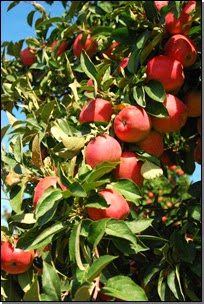
Our theme for the fourth week of school was "Apple Week." It was Johnny Appleseed's birthday on the 26th and we celebrated all week long with apple cider, applesauce, apple pie, fresh apples, apple fritters, apple turnovers, apple pancakes and apple coffee cake.

LANGUAGE ARTS
Penmanship
Here are this week's apple quotes for handwriting practice.

Reading
We read "Mrs. Gorf" from Sideways Stories from Wayside School by Louis Sachar as an interactive read-aloud and our mini lesson focused on "recalling details." Mrs. Gorf turns her misbehaving students into apples and my favorite part of the lesson is hearing the reasons children think Mrs. Gorf might be tempted to turn THEM into apples.

Poetry and Literature
Each week, I reinforce our grammar lessons through poetry. This week we are studying adjectives and Haiku is the perfect medium. I encourage students to write their poem and then go back and edit out the insignificant words. Haiku relies on cramming as many relevant descriptive words into as a small space as possible. We review the style of Haiku, remind ourselves how to determine syllables, list descriptive words and brainstorm items, places or events in nature that we can write about in our Haiku.

Also, when possible, I like to record my kids reciting their own poetry. Here is a poem written about our field trip to the mountains last week.

Nature in the Mountain
Cold and chilly hike,
early in the morning light
running waterfall.


Composition
This week we focused on the 6+1 Writing Trait CONVENTIONS (which includes grammar). The main thing we worked on is how to use commas in a series of adjectives. [Personally, I subscribe to the "less punctuation is better" philosophy (which, incidentally, is my main complaint with the English Language Arts Common Core-- they over punctuate and that makes for difficult reading material). Hence, I teach my students to omit the final comma in a general series when using the word "and."]


MATHEMATICS
This week we continue our study of the Real number system. We played an equivalent numbers matching game. Admittedly, it's quite difficult and I wouldn't recommend it for any students who haven't had significant experience with the corresponding Montessori math materials (golden bead material, fraction/decimal boards, fraction circles, etc.)

SCIENCE
Properties and States of Matter (Changing Apples into Juice, Applesauce, Slices, etc.)


HISTORY
In fourth grade we focus on several essential questions. Those that apply to this week are:
  • What does “Manifest Destiny” mean?
  • Why did the U.S. expand its territory during the 19th century and why did settlers move west?
This week we studied tall tale heroes and American legends: Johnny Appleseed, Daniel Boone, Davy Crockett, Casey Jones, Paul Bunyan and John Henry. Each of these individuals tells a story about the types of people who settled the western United States. (We will revisit several of these stories in a few weeks as we practice distinguishing between facts and opinions.)

VISUAL ART
This week we got an introduction to the Printmaking Center of our art studio. As usual, after a five minute introduction, everyone chooses to work in one of the four centers now open: drawing, painting, printmaking or collage.

Saturday, September 21, 2013

Hello Autumn!

September 16 – September 20

Our theme for the third week of school was "Hello Autumn!" The leaves in the mountains are starting to turn to reds and golds.

FIELD TRIP
This week's field trip was a hike up the canyon. We hiked up the Battle Creek trail due to the rock slides in AF Canyon from earlier this month. We talked about the settling of the area by the Mormon pioneers and how it got its name. (I have two ancestors who reportedly participated in this particular battle and it is a solemn feeling to think about the tragedy that occurred.)


We also took our science journals to sketch the different plants and animals we found. The first animal anyone found was a black widow. How he saw it from fifteen feet away in all that underbrush is beyond me! I am so terrified of spiders that I ended up having nightmares that night that a little girl tried to pick it up and got bitten. I cropped the picture below so it looks like we are closer than we actually are :).


We topped it all off with a discussion about people not cleaning up after their dogs. It was chillier than I expected but still fun.

LANGUAGE ARTS
Penmanship
Here are this week’s copywork selections.We also had a discussion related to social studies on how important good handwriting is. Lewis (of the Lewis and Clark expedition) had a dog named Seaman. For over 100 years, the dog's name was reported to be Scannon because the two look similar when written and Lewis had such poor handwriting.

Reading
We read Old Henry by Joan W. Blos and our mini lesson focused on "analyzing characters." 

Spelling 
In addition to the word sorts from the Words Their Way spelling program, we work on occasional "Wacky Words." This week we learned to spell AUTUMN. I made up new words to Rita Mae Olsen's song "It's Autumntime" and we fingerspell A-U-T-U-M-N as we sing the chorus.

Poetry and Literature
I reinforce our grammar lessons through poetry. We are learning about nouns and this week's poem was "What I Found in My Desk" by Bruce Lansky. By replacing the various nouns in Lansky's poem with our own words, we made up fun poems. I wrote my own sample to give some inspiration:

What I Found in My Purse
An apple with an ugly bruise,
a shoelace for my tennis shoes,
a coupon for a pecan pie,
a lipstick that I meant to try,
a flashlight for when it’s dark,
the keys I thought I lost at the park,
a Ziplock bag with Cheerio crumbs,
a broken phone that barely hums,
a driver’s test I almost failed,
a past due bill I should have mailed,
and one more thing, I must confess,
a note from myself: Clean This Mess!!!!

Composition
This week we focused on the 6+1 Writing Trait CONVENTIONS (which includes grammar). Since we are learning about nouns, we did another sorting activity. The objective is to sort words into one of two categories: nouns or not nouns. It is going to take a while understand the abstract nouns like love, religion, etc.

MATHEMATICS
To learn about the different sets of numbers (Natural, Whole, Integer, Rational, Irrational, Real Algebraic, Transcendental, Real, Imaginary, Complex, etc.) we played a sorting game. I printed and cut out various number cards (you can download them here). I set out six nesting boxes with the simple directions to "sort the number cards". In the past I have used different sized baskets but this summer I found nesting containers at Walmart that work perfectly.

 
I use Ziplock bags taped inside the two largest boxes for Imaginary and Irrational Numbers.


Because this activity is so similar to the spelling and vocabulary word sorts, I don't label the containers. Students look for similarities and differences in the number. It amazes me how easy it is for some kids to sort the numbers into accurate groups. There are usually a few incorrect numbers-- generally money (it can be hard to understand the details of cents vs. dollars/euros/pounds)-- and I need to help put the nested boxes in the correct order but I have found that the second time the activity is repeated, there are few, if any mistakes.


SCIENCE
This week we studied endangered Utah plants and animals and practiced science journaling while on our hike in the canyon.


HISTORY
Still focusing on Manifest Destiny, we studied Lewis and Clark (and Sacagawea) along with the details of the Louisiana Purchase (connecting to Napoleon and last week).


One of the things I find most fascinating is that some people believed that this new territory contained unicorns, wooly mammoths and seven foot beavers. (Kids find this fact amusing as well.)

VISUAL ART
This week we got an introduction to the Painting Center of our art studio. After a five minute introduction, everyone chooses to work in one of the three centers now open: drawing, painting or collage.

PHYSICAL EDUCATION
We went hiking this week.We also talked about types of walking- jogging, sprinting, hiking and race walking. (Race walking is an Olympic sport. Olympic racewalkers can "walk" a mile faster than I can run it. Pretty cool! Here is a video to check it out.)

Tuesday, April 29, 2008

Famous Dyscalculics!


Sometimes it helps to know that you are not alone! I am going to check the validity of some of these that I don't know and I'll report.

My Disabilities and Me 1 : Dyscalculia


I like this video because it lets you see how disabilities affect real people.

Dyscalculia


Math learning disabilities are frequently overlooked.

Math Education: A response to


It is a little hard to hear but worth watching. It is a response to a previous You Tube Video that I strongly disagree with.

Metric System Review


Professor Perez shows us all about the metric system...

Finding Volume: ASL Interpreter


One of the ideas we are using at our proposed charter school is the integration of ASL with academic subjects. These videos are a great example.

Monday, March 31, 2008

Jelly Bean Math


The favorite candy of the 40th President of the United State of America, Ronald Reagan, was jelly beans! He kept a glass jar of jelly beans on his desk to serve to guests and staff.

  • Ronald Reagan ate one jelly bean on January 20, 1981 (his first day in office) and each day after that, he ate double the number of jelly beans he had eaten the day before, how many jelly beans would he have eaten by the end of the month?
  • How many jelly beans would he have eaten after one month in office?
  • What would the monthly cost of these jelly beans be?
  • What was Ronald Reagan’s favorite flavor of jelly bean?
  • How many popcorn jelly beans would Ronald Regan be likely to have eaten by day 22?
  • Write an algebraic expression for the number of jelly beans Ronald Reagan would have eaten by his nth day in office.

Sunday, November 26, 2006

Math Riddle of the Day

If www.matcheez.com offers T-shirts from their Family Tee Collection in just 30 different colors, how many different combinations of shirts could we purchase for our family IF we have 5 family members? (Remember that order matters since each family member wears a different size.)

HINT
If you can't remember how to do combinations and permutations, try experimenting with just 5 colors and 3 family members then look for the pattern.
Here is an example to get you started:
If the shirt colors are red, blue, yellow, green, orange then Mom can wear 5 different colors of shirts for every shirt that dad can wear. This means that there are 25 different shirt combinations. What happens if we add in a baby who can also wear 5 different colors of shirts for each combination that Mom and Dad can wear?

Friday, May 20, 2005

Educational Shows Worth Watching

Not all "educational" shows are worth the airtime that they occupy. Here are a few of my favorite math shows:

Cyberchase
http://pbskids.org/cyberchase/
This PBS show does name Hacker as the "bad guy" but aside from that, it is an excellent show. National math standards are addressed. Concepts are clearly presented. Ideas build from the simple to the complex. Real-life connections are included at the end of each episode. Besides it's a cartoon and it's FUN!

Math Monsters
http://www.mathmonsters.com/
This is my favorite educational show. It is a cartoon series produced with the National Council of Teachers of Mathematics. This is reflected in its goals, teaching methods and concept presentation. My children love to watch it over and over. Appropriate for ages 3-9.

Mathematics is Elementary
http://www.ait.net/products/mathematics/
A good series for home-school students as a supplementation for a basic program.

The Number Crew
http://www.thenumbercrew.us/
This series is a claymation show for very young children and focuses on basic number concepts.

Ms. Math
http://www.cptv.org/msmathhome.html
This series is intended for parents and teachers who wish to help their children understand the beuaty of mathematics. On demand video is available.

Check your local public TV station to see times and airdates.

Saturday, January 08, 2005

Cold Hard Cash- Lesson 1

To understand money, children must handle money. I don't mean the little brown and gray, plastic discs used in elementary math classrooms. I guarantee that the gas company is not impressed when you try to pay your bill with mimeographed sheets containing drawings of one dollar and five dollar bills. Children must handle money and I mean cold hard cash.

Money is a concrete example of mathematics in action. It encompasses the metric system, addition, subtraction, decimals, fractions, percents, counting, multiplication, division, story problems, interest, exponential growth, negative numbers, accounting systems and regrouping (to name a few.) It is a common joke that a math professor at the local university can perform complicated computations and prove complex theorems but cannot balance his own checkbook. This is absurd. We teach our children mathematics so that their lives may be enriched. We want them to be successful adults. Learning how mathematics connects with daily life is crucial to this goal.

Teachers who teach at inner city schools tell me that their students do well with money. This may be attributed to the fact that a large percentage of their parents cash their paychecks and then purchase household goods with the cash. Many of them do not have checking accounts. Few have credit cards. Seeing cash and using it for purchases gives money a tangibility that desk work cannot.

Teaching money is best done by parents at home. Good teachers might use worksheets with story problems about money. They might have students work in centers counting money. Some teachers may drill students on coin names and values. Teachers may even attempt to mimic real life by creating classroom stores or by using reward systems that include a classroom monetary currency. However, despite their best efforts, teachers do not prepare students to deal with a real life economic system. Parents must take this responsibility. To supplement the traditional teaching methods of most public schools, parents can use a variety of techniques to aid their children in learning about money.

I recommend that every child over age 2 be given an allowance. The dollar amount of the allowance is unimportant. The child must receive this money frequently and must be paid in cash. IOU's, deposits to a savings account or payments made with "fake" money defeat the purpose of this exercise and MUST BE AVOIDED! Many Americans have deeply rooted issues with money and find it hard to simply give their children money. An allowance is NOT earned through doing household jobs. That would be a wage. An allowance is NOT earned through good behavior. That would be a reward. An allowance is simply an allotted amount of money GIVEN to the child. Having children earn their own money is not a bad idea. However, it rarely provides children with enough opportunities to practice using money. If your own financial situation severely limits the amount of money you can give your child, try this technique.

Many parents claim that they cannot afford to give an allowance and yet they purchase items for their children such as shampoo, clothing, lunch tickets, toothbrushes or pencils. Explain to your child that the purpose of this allowance is to teach them about money. Instead of purchasing all of your child's household needs, allow them to have money equal to what you would have spent on toothpaste, notebooks, crayons, etc. Follow the steps below every time you give money to your child. Some steps can be adapted or expanded to fit the age of the child.

AT HOME:
  • Help them to write a budget and a shopping list so that they can see where the money must be spent.
  • As you give the money to the child, have them count it out loud (with your help, if necessary.)
  • Have your child sort the money they receive by type of coin.
  • Help them arrange money into piles equivalent to a one dollar bill. Show them that money can be combined in many ways.
  • Remind the child that money is important and must be kept safe. Brainstorm appropriate ways to store and carry money.
AT THE STORE:
  • Take your child to the store. Older children may carry small amounts of money at the store. Parents should watch carefully since children will set their money on the ground when distracted by an item at the store. (Even many adults leave their purses sitting unattended in shopping carts while they browse the merchandise.)
  • Help children locate the price tags of the items they need to purchase. Let them read the numbers. Show them how to compare prices.
  • If you have a pocket calculator- bring it. A child can total up the cost of their items as they shop so that there will be no surprises at checkout. A child will begin to see that we make choices at the store based both on what we want to purchase and on the price of the item.
  • Point out each step the checker takes in figuring the prices. A self checkout lane can be fun for children to practice locating the barcode and scanning it themselves. Show your child how to double check the price of the item on the screen.
  • The checkout provides a wonderful opportunity to talk about sales tax. Sales tax is a percentage and older children can figure the tax before the checker gives them the total.
  • Let your child count out the cash as they pay the cashier. This may take a little extra time. Don't shortcut the process simply because someone behind you is in a hurry. You are teaching your child an important life skill.
  • Discuss what happens if you cannot give the cashier the exact amount and must receive change.
  • Remind your child to take their receipt. Explain to your child how to read a sales receipt. Discuss which receipts must be saved and which may be thrown away.
These techniques take extra time but can quickly become routine for you and your child. Remember that you are teaching your child an important life skill. It is better that your child should make small mistakes when you can help them than for them to make bigger financial errors when they are on their own and have no safety net.

Monday, December 13, 2004

Thought for the Day

"There is a great danger in the present day lest science-teaching [and mathematics education] should degenerate into the accumulation of disconnected facts and unexplained formulae, which burden the memory without cultivating the understanding."

--J. D. Everett [In the preface to his 1873 English translation of Elementary Treatise on Natural Philosophy by A Privat Deschanel. (D. Appleton and Co.)]

Monday, November 22, 2004

Pop Quiz

Is the following possible:
11+ 2 = 1 ?
If yes, please give an example. If no, please explain why not.

Monday, November 15, 2004

Philosophy of Mathematics Education

Philosophy of Mathematics Education

Three things are essential in a good math classroom:

Counter Intuitive Thinking
Students need experience with counter-intuitive problems to develop logical thinking skills.

Manipulatives
Manipulatives not only help students understand concepts more clearly, they also give concrete examples of how mathematics surrounds us. For instance, baby toys can teach integral calculus, a Slinky demonstrates geometry formulas, sewing patterns are derived from statistics, M&Ms follow patterns of probability, applesauce teaches about similar figures, fingerprints coincide with the binary system used by computers.... Fun examples are everywhere.

Technology
Calculators and computers allow students the freedom to explore the beauty of mathematics without the time consuming calculations. Children can understand complicated mathematical ideas even though they cannot yet perform the cumbersome arithmetic that makes those concepts possible.